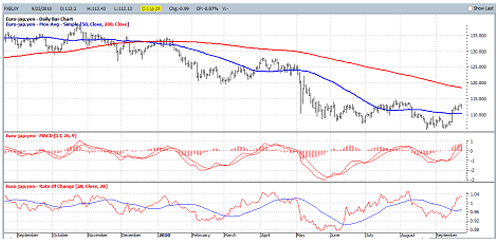
Our first grade in forex literacy is for understanding how to read the price quote. In forex, currencies are always quoted in pairs. In other words, it’s only possible to value a currency in terms of another one. If you want to buy 100 Euros, how are you going to pay for it? If you were to pay in euros, you’d not be currency trading, and when you use another currency to fund your purchase of the euros, you’re actually creating a forex quote.
It’s actually quite easy to evaluate forex quotes once you get the hang of it, and the fastest way to learn is by considering some examples:
EUR/USD 1.2786
So what does the above quote tell us? What it says is that 1 Euro is able to buy 1.27 units of the US currency. Or, continuing on our previous transaction, we would have to pay
127 USD for 100 Euros we wanted to buy.
But in fact this value is only the average of the bids (price to buy) and offers (price to sell) for a currency pair at a particular time. The bid-ask spread is usually very low for the most liquid pairs, such as the EUR/USD, but at times of illiquidity in the markets, as before a statistical news release, or a central bank decision, the spread can widen to much greater levels.
The quote represents the best pricing that the world market offers for a currency pair at a particular moment. A quote on a computer does not usually include all of the offers and bids all over the world, but because of the very liquid nature of the forex market, any significant difference in quotes across different parts of the world is very quickly eliminated through computer-based, automatic arbitrage, and consequently, except at times of market turmoil the difference between regional quotes is quite low.
So let’s say return to the EUR/USD quote. Our quote is at 1.2786, and the bid-ask spread is at 0.009, as stated by the broker. What this means is that there’s a difference of 0.9 cent between what you pay to buy the same currency pair, and what you’d receive if you were selling it. There’s always a spread in even the most liquid markets, but the spread is usually widened further by the brokerage firm, so that it can make a profit from the individual traders’ deals.
The important point to keep in mind when evaluating quotes is that one quote is valid for only a fraction of a second. At times of market tension, great fluctuations can occur within the scope of one minute, rendering the quote almost useless. Despite the great focus on prices and price patterns among many traders, it’s always advisable to keep the time of the day, of the year, and the emotional atmosphere of the market in mind while deciding on what we should do about a particular quote. For example, quotes during the last few weeks of the year, or in the Thanksgiving week, or at about an hour before the opening of the US market have far less value in determining future price direction and trends than those seen during an ordinary business day at regular hours. So, to repeat, the trader must not only know the price quote at a given moment, but also the seasonal, hourly, and emotional backgrounds that influence the quote before he decides to make a trade on the information.
That skill can be gained through practice, and is perhaps easier learned through experience than reading.
It’s actually quite easy to evaluate forex quotes once you get the hang of it, and the fastest way to learn is by considering some examples:
EUR/USD 1.2786
So what does the above quote tell us? What it says is that 1 Euro is able to buy 1.27 units of the US currency. Or, continuing on our previous transaction, we would have to pay
127 USD for 100 Euros we wanted to buy.
But in fact this value is only the average of the bids (price to buy) and offers (price to sell) for a currency pair at a particular time. The bid-ask spread is usually very low for the most liquid pairs, such as the EUR/USD, but at times of illiquidity in the markets, as before a statistical news release, or a central bank decision, the spread can widen to much greater levels.
The quote represents the best pricing that the world market offers for a currency pair at a particular moment. A quote on a computer does not usually include all of the offers and bids all over the world, but because of the very liquid nature of the forex market, any significant difference in quotes across different parts of the world is very quickly eliminated through computer-based, automatic arbitrage, and consequently, except at times of market turmoil the difference between regional quotes is quite low.
So let’s say return to the EUR/USD quote. Our quote is at 1.2786, and the bid-ask spread is at 0.009, as stated by the broker. What this means is that there’s a difference of 0.9 cent between what you pay to buy the same currency pair, and what you’d receive if you were selling it. There’s always a spread in even the most liquid markets, but the spread is usually widened further by the brokerage firm, so that it can make a profit from the individual traders’ deals.
The important point to keep in mind when evaluating quotes is that one quote is valid for only a fraction of a second. At times of market tension, great fluctuations can occur within the scope of one minute, rendering the quote almost useless. Despite the great focus on prices and price patterns among many traders, it’s always advisable to keep the time of the day, of the year, and the emotional atmosphere of the market in mind while deciding on what we should do about a particular quote. For example, quotes during the last few weeks of the year, or in the Thanksgiving week, or at about an hour before the opening of the US market have far less value in determining future price direction and trends than those seen during an ordinary business day at regular hours. So, to repeat, the trader must not only know the price quote at a given moment, but also the seasonal, hourly, and emotional backgrounds that influence the quote before he decides to make a trade on the information.
That skill can be gained through practice, and is perhaps easier learned through experience than reading.

 The relative lack of government intervention in controlling the value of the currency in the forex market.
Relatively high interest rate offered by the Royal Bank of Australia (RBA).
The strategic location of Australia in the Asia-Pacific region.
Free export and import of the currency up to A$10,000.
Relative stability in the country’s political and economic environment.
Lower impact of global recession on the Australian economy.
Australia Forex: Regulations for Brokers
Forex trading in Australia is regulated by the Australian Securities and Investment Commission (ASIC). The Australian law and regulations necessitate:
All brokers offering retail forex services to be registered with the ASIC.
All forex brokers to have an Australian Financial Services License. Alternatively, they could be licensed with the RBA.
Australian Forex: Importance of the Central Bank
The RBA plays a critical role in the Australian forex market. It meets 11 times in a year to discuss issues related to its monetary policy and interest rates. Its decision on interest rates can affect the value of the dollar in the Australianforex market.
Australia Forex: Most Active Trading Hours
The best hours to trade in the Australian currency is around the time when Tokyo trade opens. This is the time at which the Australian economic data, which has a direct impact on the value of the country’s currency, is released.
The relative lack of government intervention in controlling the value of the currency in the forex market.
Relatively high interest rate offered by the Royal Bank of Australia (RBA).
The strategic location of Australia in the Asia-Pacific region.
Free export and import of the currency up to A$10,000.
Relative stability in the country’s political and economic environment.
Lower impact of global recession on the Australian economy.
Australia Forex: Regulations for Brokers
Forex trading in Australia is regulated by the Australian Securities and Investment Commission (ASIC). The Australian law and regulations necessitate:
All brokers offering retail forex services to be registered with the ASIC.
All forex brokers to have an Australian Financial Services License. Alternatively, they could be licensed with the RBA.
Australian Forex: Importance of the Central Bank
The RBA plays a critical role in the Australian forex market. It meets 11 times in a year to discuss issues related to its monetary policy and interest rates. Its decision on interest rates can affect the value of the dollar in the Australianforex market.
Australia Forex: Most Active Trading Hours
The best hours to trade in the Australian currency is around the time when Tokyo trade opens. This is the time at which the Australian economic data, which has a direct impact on the value of the country’s currency, is released.
 Sources for currency demand on the FX market:
The currency of a growing economy with relative price stability and a wide variety of competitive goods and services will be more in demand than that of a country in political turmoil, with high inflation and few marketable exports.
Money will flow to wherever it can get the highest return with the least risk. If a nation’s financial instruments, such as stocks and bonds, offer relatively high rates of return at relatively low risk, foreigners will demand its currency to invest in them.
FX traders speculate within the market about how different events will move the exchange rates. For example:
News of political instability in other countries drives up demand for U.S. dollars as investors are looking for a "safe haven" for their money.
A country’s interest rates rise and its currency appreciates as foreign investors seek higher returns than they can get in their own countries.
Developing nations undertaking successful economic reforms may experience currency appreciation as foreign investors seek new opportunities.
Sources for currency demand on the FX market:
The currency of a growing economy with relative price stability and a wide variety of competitive goods and services will be more in demand than that of a country in political turmoil, with high inflation and few marketable exports.
Money will flow to wherever it can get the highest return with the least risk. If a nation’s financial instruments, such as stocks and bonds, offer relatively high rates of return at relatively low risk, foreigners will demand its currency to invest in them.
FX traders speculate within the market about how different events will move the exchange rates. For example:
News of political instability in other countries drives up demand for U.S. dollars as investors are looking for a "safe haven" for their money.
A country’s interest rates rise and its currency appreciates as foreign investors seek higher returns than they can get in their own countries.
Developing nations undertaking successful economic reforms may experience currency appreciation as foreign investors seek new opportunities.